● All responses will be collected as entries in a draw for a printed set of the Métis Foundational Knowledge Themes
(the draw will take place at the end of the month).
● You may respond to the questions at any time throughout the month; it does not have to be the same week that it was posted.
● In your post, please ensure you reference which question you're responding to (For example: Week 1 Trivia)
In a post below, please introduce yourself!
What is your name?
Where are you joining from?
Why did you sign up for the Moodle course?
WEEK 1 TRIVIA:
Métis in Alberta have spoken four languages traditionally. Which one is missing?
Michif, French, English and ?
WEEK 1 REFLECTION:
"Michif language is the essence of the [Métis] culture. If you learn the language, you will learn who we are as a people." - Vice-President Dan Cardinal
The languages spoken by Métis are inherently connected to Métis culture and identity. As you learn about the languages traditionally spoken by Métis, what do you learn about Métis identity and culture?
WEEK 2 TRIVIA:
The core Métis value of kinship, community, and networking is evident in which of the following traditions?
a) celebrations
b) sharing extra wild game
c) traditional house design
d) all the choices are correct
WEEK 2 REFLECTION:
“Without [their] culture, without that strong line from [their] forefathers, no [person] knows who [they] really [are]. If one does not know who [they are], [they] cannot possess pride or dignity for [themselves] or [their] people.”
-Dr. Anne Anderson, Métis scholar and leader
Dr. Anne Anderson highlights the key relationship between a person's identity and their cultural heritage. Why would it be important to celebrate distinct Métis culture in an educational community?
WEEK 3 TRIVIA:
Why do people commemorate Louis Riel on November 16th?
WEEK 3 REFLECTION:
“Through the hunt, Métis could understand themselves as a web of kin relations, expressing a collective political will through an assembly of inter-related families that choose a mutually agreed upon leadership.”
–Adam Gaudry, “Kaa-tipeyimishoyaahk—‘We Are Those Who Own Ourselves’:
A Political History of Métis Self-Determination in the North-West, 1830-1870” (PhD
dissertation, University of Victoria, 2014), 29.
Dr. Adam Gaudry highlights how wahkohtowin (being related or relationality) is a core framework guiding Métis governance. Is this a narrative you have encountered before when learning about the Métis? Why would it be important to reinforce wahkohtowin and otipemisiwak as Métis Ways of Being for learners?
WEEK 4 TRIVIA:
Match each term to the correct definition.
Terms:
1) Wahkohtowin
2) Otipemisiwak
Definitions:
a) A word in the Cree language expressing the idea that the Métis lead, govern, care for, and own themselves.
b) A word in the Cree language describing the importance of kinship among family, extended family, and relationships built extending to natural and spiritual worlds, human and non-human, living and not living worlds.
WEEK 4 REFLECTION:
Métis resilience is expressed in the way Métis name themselves as otipemisiwak. In what ways do Métis live out resilience?
TRIVIA 5:
Where do Métis people in Alberta live today?
REFLECTION 5:
“Learning history through textbooks is not enough . . . It is important for students to learn by hearing stories of the past. . . . Stories help to create empathy and engage students, giving them an opportunity to see things from another perspective."
- Norma Spicer
In what ways do K-12 students in Alberta benefit from learning about Métis stories around Alberta? Share an example of how you have witnessed a learner’s perspective develop/change by learning about Indigenous histories in their area, if you have one.
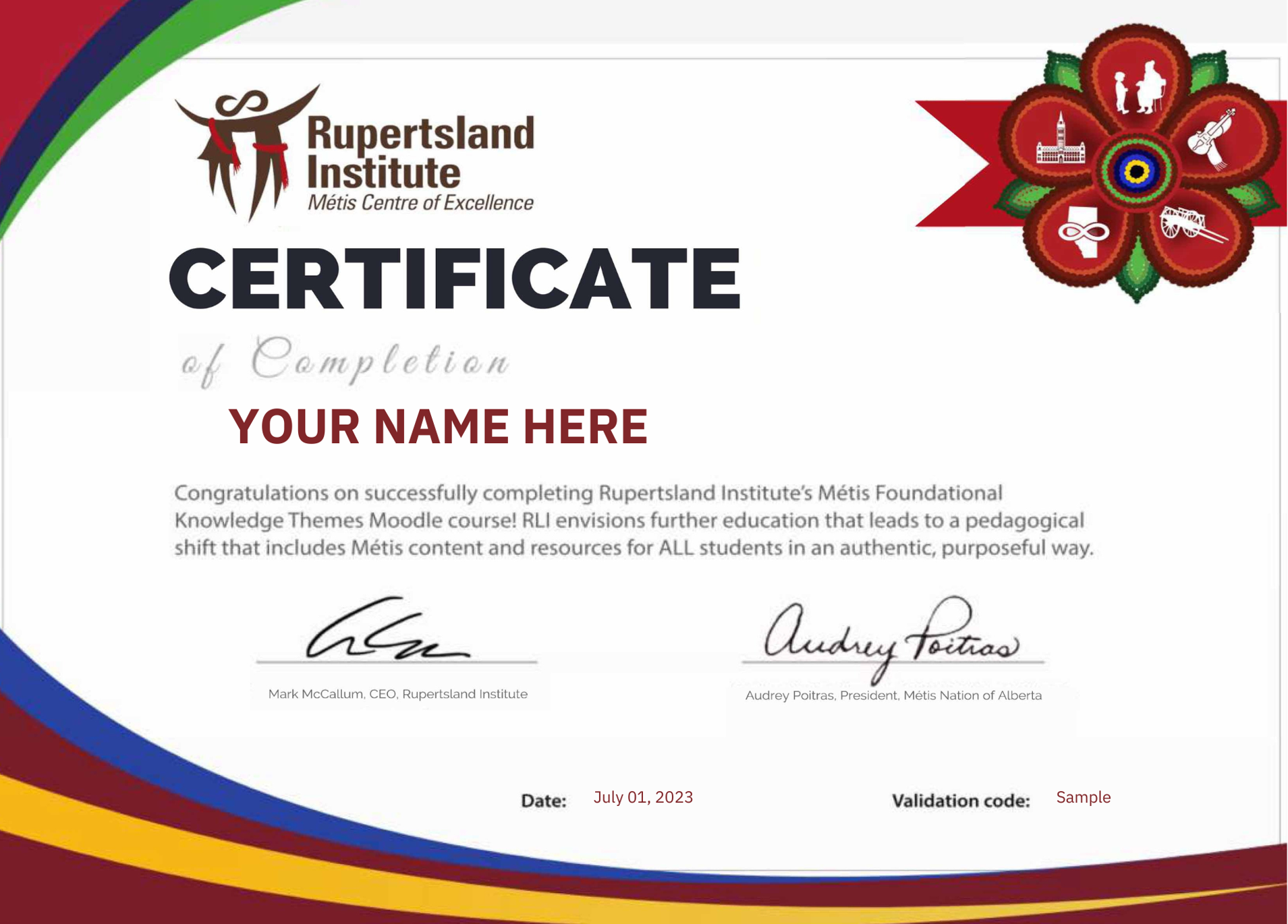
After you finish the course, you will receive the RLI's Métis Foundational Knowledge Themes Moodle Course Certificate of Completion:
Happy learning!
Rupertsland Centre for Teaching and Learning